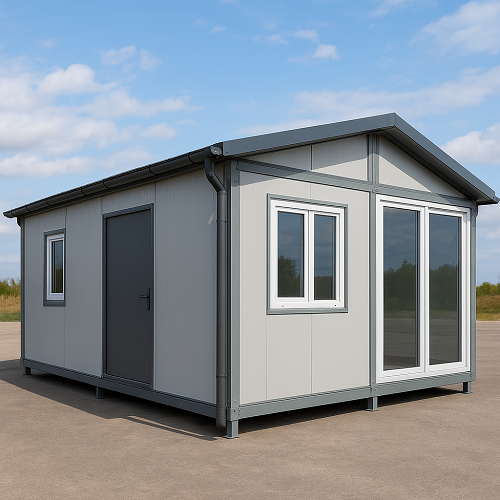
As a manufacturer and supplier of modular building solutions, we’re proud to introduce the Sale Sale Light Steel Folding Prefabricated House Villa — a fast-deploy, durable, economical and highly configurable prefabricated villa system designed to meet modern needs for temporary and permanent housing, commercial spaces, and specialized facilities.
1. Product overview — what it is and what it does
The Sale Light Steel Folding Prefabricated House Villa is a modular living or commercial unit built from a galvanised light steel frame with foldable panels and prefabricated components. It arrives largely factory-assembled, packs flat for efficient transport, and can be unfolded and finished on-site quickly. The product is designed to provide comfortable, code-compliant, and cost-effective space — from single-room villas to multi-room homes and small commercial units — while minimizing onsite construction time and disruption.
Primary capabilities:
- Rapid deployment: a single unit can be installed and ready for basic use within hours after delivery.
- Modular scalability: units can be combined, stacked (where allowed), or arranged to form multi-room villas, offices, dormitories, clinics, cafés, or retail kiosks.
- Transport efficiency: foldable design reduces cargo volume and shipping costs.
- Durable, low-maintenance structure suitable for repeated relocation or long-term installation.
2. Product functions & typical uses
The Sale light steel folding villa serves numerous functions across residential, commercial, and industrial contexts:
Residential:
- Temporary or permanent tiny homes and guest houses
- Worker / staff housing on construction or mining sites
- Emergency shelter after disasters or during relief operations
- Vacation cottages and park villas
Commercial & institutional:
- On-site offices, meeting rooms, and reception areas
- Clinics, first-aid posts, and testing stations
- Cafés, kiosks, pop-up retail stores and exhibition booths
- Classrooms, training rooms, or community centers
Industrial & logistics:
- Security guard posts, weighbridge offices, and site control rooms
- Storage office combos, rest areas for truck drivers
- Remote research stations and site laboratories
Specialized uses:
- Film & event backstage units and makeup rooms
- Military logistics and forward operating posts (non-sensitive applications)
- Remote tourism & eco-lodge modules (with appropriate finishes)
3. Product features
Structural & material advantages:
- Light steel frame: high strength-to-weight ratio, precision-fabricated, corrosion-protected (galvanized / painted).
- Folding mechanism: engineered hinges and locks allow walls/floors to fold inward for transport, then securely lock into position on site.
- Prefabricated panels: insulated sandwich wall panels (EPS, rock wool, or PU options) for thermal and acoustic performance.
- Durable exterior cladding: weather-resistant metal or composite facades; optional decorative finishes.
Performance & usability:
- Rapid installation: minimal foundation requirements — concrete pads, screw piles, or adjustable supports — and simple mechanical/bolted connections.
- Thermal comfort: multiple insulation options and glazed windows/doors to meet local climate requirements.
- Flexibility: interior partitions, electrical, plumbing and HVAC pre-installed or pre-routed; easily reconfigured.
- Transport & logistics friendly: compact folded dimensions maximize shipping efficiency and reduce freight cost.
- Sustainable: recyclable steel, reduced onsite waste, and minimal site disturbance.
- Safety and compliance: designed to meet local structural and fire-safety standards; smoke detectors, fire doors, and optional fire-retardant materials available.
Convenience & maintenance:
- Low maintenance: corrosion-resistant materials and easily replaceable panels.
- Modular replacements: damaged elements can often be swapped quickly without dismantling the whole unit.
- Optional integrations: solar-ready roofs, greywater systems, and off-grid packages.
4. Typical specifications
Below is a representative specification package. We offer custom sizes and finishes; the table shows common baseline options.
General:
- Typical folded transport size (single unit): approx. 2.3 m (W) × 2.4 m (H) × 6.0–12.0 m (L) depending on layout.
- Typical unfolded internal area (single unit): 18 m² – 72 m² (single to multi-room).
- Structure: Galvanized cold-formed light steel frame (Zn coating per spec).
- Wall panel: Sandwich panel — options: EPS (expanded polystyrene) 50–100 mm, rock wool 75–100 mm, PU 50–80 mm.
- Roof: insulated sandwich roof panel; slope or flat options; load-bearing per local code (e.g., snow/wind loads).
- Floor: OSB or plywood on steel joists + finished flooring (vinyl/laminate/ceramic tile).
- Doors/windows: UPVC or aluminium frames; double-glazed options.
- Finish: powder-coated steel, composite cladding, or decorative panels.
- Insulation R-value: varies by panel choice (specify per climate).
Mechanical / electrical:
- Electrical: pre-wired lighting circuits, outlets, breaker panel; optional solar or generator integration.
- HVAC: split-type mini-duct or wall-mounted AC; pre-routed condensate and power.
- Plumbing: pre-installed waste/drain and water supply stub-outs; pre-routed piping for bathrooms and kitchenettes.
- Fire safety: smoke detectors standard; optional fire extinguisher bracket and sprinkler-ready.
Structural capacities (typical; must be enforced by local engineer):
- Designed wind resistance up to code-specified speeds (e.g., 0.5 – 1.0 kN/m² uplift depending on anchoring).
- Live load floor design: commonly 2.0 – 3.0 kN/m² (adjustable to requirements).
Weights:
- Unit shipping weight varies with size and specs — for reference a 20 ft folded villa with insulated panels may weigh 1,800–3,500 kg.
Customization:
- Multi-unit connection kits, inter-unit corridors, stair/railing kits for stacked configurations, and accessory packs (furniture, kitchens, bathrooms).
5. Instructions for use
A. Site preparation
- Foundation: Prepare a simple foundation: concrete pads, strip foundations, screw piles, or compacted gravel platform, level and stable. Foundation specification should match local codes and soil conditions.
- Access: Ensure truck/crane access for unloading and adequate maneuvering space for unfolding and positioning.
- Utility stubs: Preplan water, sewer, electricity and data conduit entry points to align with the unit’s utility locations.
B. Unloading & installation (typical steps)
- Inspect packed unit on arrival for transportation damage.
- Position unit on prepared supports using crane or forklift pads as recommended.
- Unlock and carefully unfold walls/roof according to manufacturer’s folding sequence (we supply a step-by-step mechanical unfolding guide).
- Secure all locking pins, bolts and hinge fasteners. Verify panel seals and gaskets are seated properly.
- Connect adjacent modules (if applicable) using supplied connection plates, seals and bridging systems.
- Anchor the unit to foundation with provided anchors/screws. Torque to specification.
- Connect utilities: electrical main, water inlet, sewage/drain connection and HVAC refrigerant lines if split systems require field-connection (we provide piping junction points).
- Finish interior as required (connect furniture modules, install fixtures, perform final cleaning).
C. Commissioning & inspection
- Test electrical system, breakers, and all lighting and outlets.
- Test plumbing: pressure test supply lines and check drainage.
- Test HVAC and ensure airflow and thermostat control.
- Check door/window seals and hardware.
- Walkthrough with client, demonstrating operation of folding mechanisms, locks, and safety features.
D. Operation & maintenance
- Daily: basic cleaning, check for obvious leaks or seal failures.
- Monthly: inspect mechanical hinges and lock fasteners; tighten as needed; test smoke detectors and electrical grounding.
- Annually: corrosion/paint inspection, reseal perimeter joints, check roof integrity and insulation condition.
- Relocation: reverse installation steps. Before folding, remove fragile fixtures, secure interior items, and follow folding and transport locking procedure. Use special transport braces if long-distance moves are anticipated.
E. Safety notes
- Only trained technicians should operate unfolding/folding mechanisms for the first time.
- Use personal protective equipment (PPE) during installation.
- Do not modify structural frame without consulting manufacturer/engineer.
- Comply with local building and fire safety regulations — certain permanent installations may require permits.
6. Applicable industries & scenarios
- Construction & Mining: worker camps, site offices, welfare units.
- Disaster Relief & Humanitarian: rapid emergency shelters, medical triage units.
- Hospitality & Tourism: glamping pods, resort guest units, park villas.
- Healthcare & Social Services: temporary clinics, testing stations, vaccination posts.
- Retail & Events: pop-up stores, exhibition booths, ticketing offices.
- Education & Training: modular classrooms, field training rooms.
- Government & Security: border posts, temporary administration offices.
- Agriculture & Remote Operations: agro-staff housing, remote research shelters.
7. Target customers
We design and market these villas to a wide set of customers:
- Construction companies and contractors needing on-site housing and offices.
- Government agencies and NGOs involved in disaster response and temporary housing.
- Real estate developers building staged, modular resort or community housing.
- Facility managers for events, exhibitions and seasonal retail.
- Mining and energy companies needing transportable staff accommodation.
- Small businesses launching pop-up retail or food & beverage kiosks.
- Property owners who want an affordable secondary unit (guest house, home office).
- Architects and designers seeking flexible modular building systems for projects.
8. Why choose our Sale Light Steel Folding Prefabricated House Villa?
- Speed: dramatically shorter lead time compared with traditional construction.
- Cost-effectiveness: lower labor and onsite cost; reduced transport expenses due to folding design.
- Quality control: factory-controlled prefabrication ensures consistent build quality.
- Adaptability: modular and repeatable design supports many layouts and upgrade paths.
- Sustainability: less site waste and recyclable materials reduce environmental footprint.
- Service: we deliver full support — engineering drawings, installation training, spare parts and after-sales maintenance plans.
9. Ordering, customization & compliance
We offer:
- Multiple standard sizes and bespoke dimensions.
- Choice of insulation, interior finishes, door/window packages, and fixtures.
- Integration of off-grid power (solar + battery), greywater systems, and security systems.
- Engineering packages for local permit submission (load calculations, wind/snow design) where required.
Upon request we provide:
- Detailed CAD/3D models, foundation plans, and connection detail drawings.
- Turnkey solutions including transport, installation supervision, and commissioning.
The Sale Light Steel Folding Prefabricated House Villa is a flexible, rapid, and economical building solution that bridges the gap between temporary shelters and permanent construction. Whether you need quick worker housing, a portable clinic, a pop-up shop, or a modular villa, our system delivers speed, durability, and configurability.